
When we talk about modern car safety, it is helpful to think of it as a two-part defence system. You have features that work to stop a crash from happening, and you have features that protect you if one becomes unavoidable. These are known in the industry as active and passive safety systems, and together they create a powerful safety net.
How Modern Car Safety Systems Work Together
Think of your car’s safety features as a highly coordinated team with two distinct roles: the ever-watchful co-pilot and the silent, heavy-duty bodyguard. It is the simplest way to get your head around the two fundamental types of safety technology in every modern vehicle.
First up is active safety, which plays the role of the co-pilot. These are the smart technologies designed to proactively prevent an accident. Using a network of sensors, cameras, and clever software, they constantly monitor what is happening around the vehicle and how you are driving, ready to step in if things get risky. For instance, a system might detect you are drifting out of your lane on the motorway and gently nudge the steering to correct your path.
Then you have the passive safety systems: the silent bodyguards. These features lie in wait, completely dormant, until the moment a collision is inevitable. Their one and only job is to minimise injury to everyone inside when an impact occurs. They are the car’s built-in emergency response team.
This infographic neatly breaks down how these two concepts form the bedrock of vehicle safety.
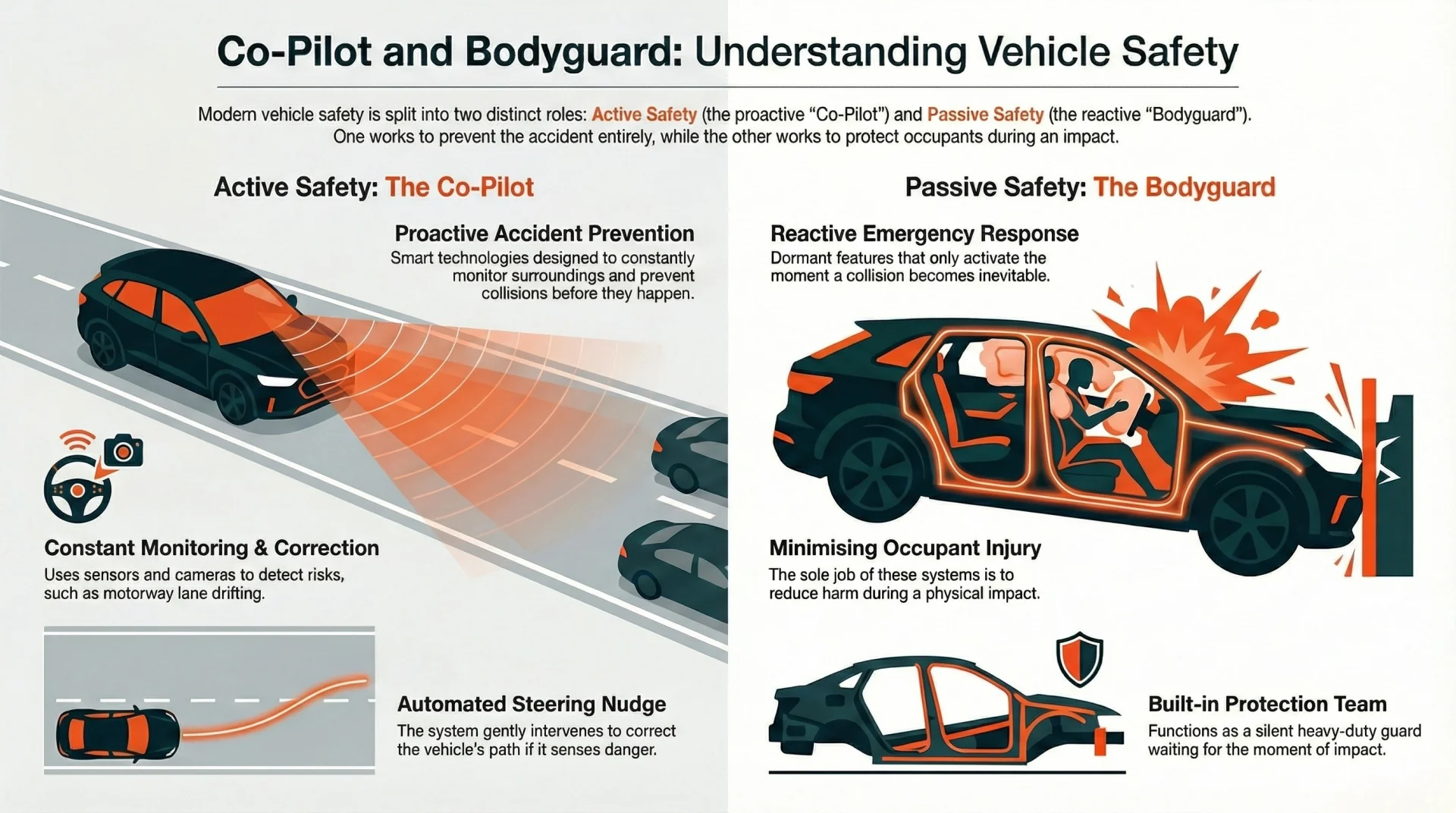
As you can see, it is a clear division of labour. The active tech is all about prevention, while the passive systems are there for protection. It is their teamwork that truly makes a difference.
A Coordinated Defence
These two systems are engineered to work in perfect harmony. For example, an active feature like Electronic Stability Control (ESC) might activate to help a chauffeur regain control on a slippery patch of road, completely preventing a spin-out. But if a collision still happens, the passive features like airbags and seatbelt pre-tensioners deploy in milliseconds to protect the occupants.
The most effective safety net is one that combines accident avoidance with robust crash protection. Modern vehicles integrate these systems so that one takes over where the other’s capability ends.
Of course, all this advanced technology relies on a well-maintained vehicle. That is why foundational checks, like maintaining vital safety components like your brake fluid, are non-negotiable. It ensures the car’s core systems are always ready to perform when you need them most. Ultimately, this layered approach provides a powerful defence against the unpredictable nature of driving.
Key Milestones in UK Car Safety Evolution
The incredibly advanced safety features we take for granted in modern cars did not just appear out of nowhere. They are the product of a long and often hard-won journey, driven by innovation, regulation, and a growing public demand for better protection on British roads. This story did not start with sophisticated electronics, but with a simple focus on making sure cars were mechanically sound in the first place.
A pivotal moment came in 1960 with the introduction of the Ministry of Transport test, which we all now know as the MOT test. Back then, it was a fairly basic check-up for brakes, steering, and lights, but only for cars over ten years old. This simple idea established a critical principle: every car on the road had to meet a minimum standard of safety, laying the groundwork for everything that followed.
Once that foundation was in place, the focus began to shift from basic roadworthiness to protecting people inside the car during a crash.
The Seatbelt Revolution
You could argue that the single most impactful safety development was the humble seatbelt. While manufacturers had offered them as optional extras for years, getting people to actually use them required a major legislative push.
The journey started back in 1967, when it became law for all new cars sold in Britain to be fitted with front seatbelts. But it took until 1983 for wearing them to become compulsory, a change that triggered an immediate 90% compliance rate among drivers. The momentum continued, with rear seatbelts mandated from 1987 and wearing them becoming a legal requirement for back-seat passengers in 1991. You can find more fascinating details about this evolution on the AA’s website.
This legal shift proved a vital point: passive safety systems are only effective if people use them correctly. It was a realisation that paved the way for future public awareness campaigns and tougher regulations.
You can see a clear pattern emerging here. First, a new safety feature is invented and proven to work. Next, it is mandated for manufacturers to include in their vehicles. Finally, its use becomes a legal must for drivers and passengers.
Building on Decades of Progress
The success of the seatbelt laws and the MOT test created a powerful momentum. Regulators and the public alike realised that setting higher standards saved lives, which in turn pushed car makers to compete on safety credentials. This created the perfect climate for the rapid development of airbags, reinforced vehicle frames, and crumple zones.
Each of these milestones built on the one before, transforming vehicle safety from a simple mechanical checklist into the complex, integrated system we have today. Understanding this history is key to appreciating the incredible network of active and passive systems that keep us safe, showing how decades of learning and legislation have shaped the modern vehicle.
Understanding Passive Safety: Your Silent Protectors
While active systems are busy trying to prevent a crash, passive safety features are the silent guardians that spring into action when an impact becomes unavoidable. Their one and only job is to protect everyone inside the car by managing the immense forces of a collision. Think of them as the vehicle’s built-in bodyguards, engineered to absorb, deflect, and soften the blow.
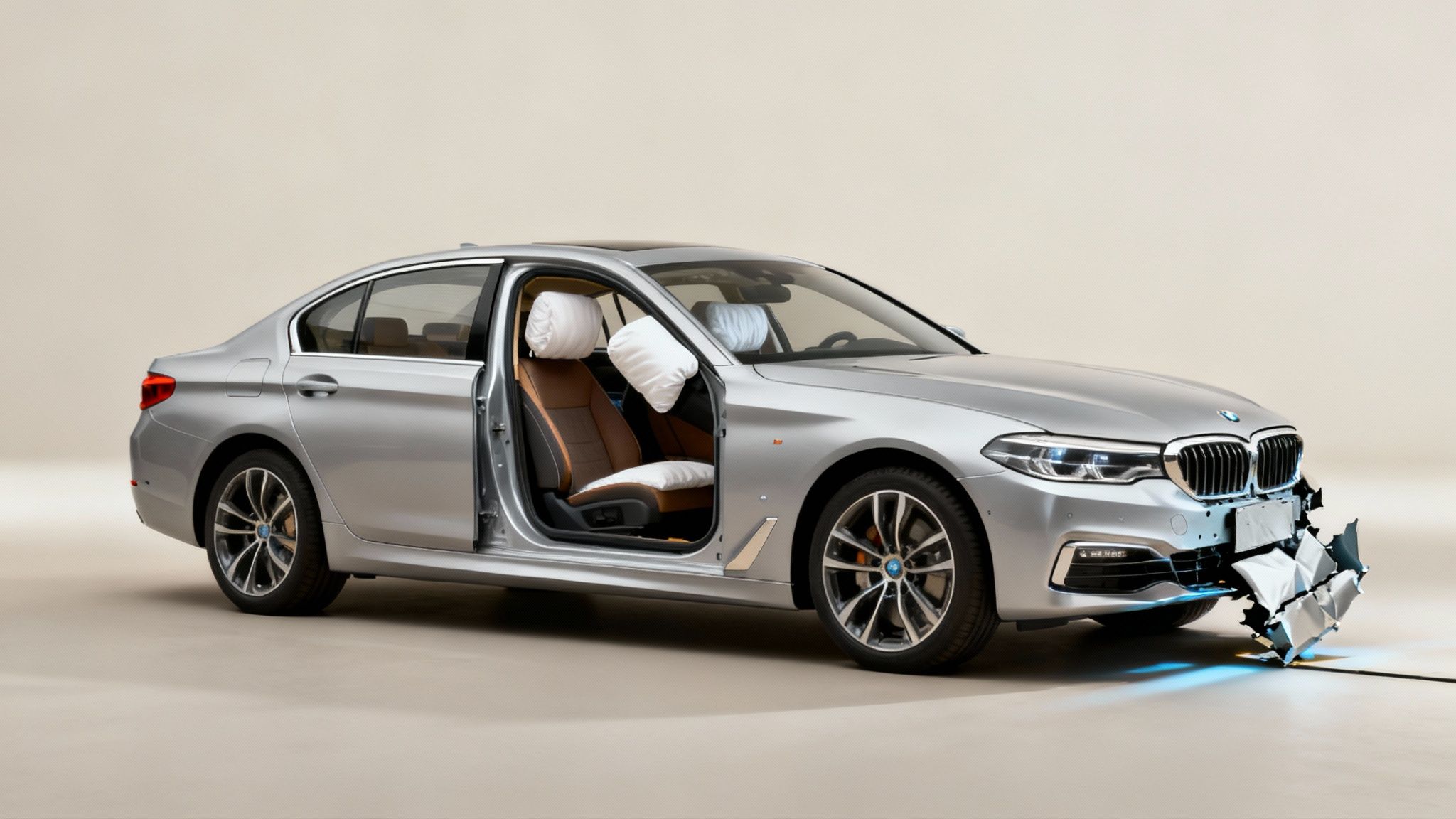
This protection comes from a whole suite of technologies working together in the blink of an eye. The most important of these are built directly into the car’s structure, acting as its first and most critical line of defence.
The Car’s Built-In Shock Absorbers
At the very heart of passive protection are crumple zones. Imagine these as the car’s own shock absorbers. Placed at the front and back of the vehicle, these zones are designed to collapse in a controlled, predictable way during an impact. This managed deformation absorbs a huge amount of kinetic energy that would otherwise be violently transferred to the passengers.
Working hand-in-hand with crumple zones is the reinforced safety cell, a super-rigid cage made of high-strength steel that encloses the passenger compartment. While the front and rear are designed to fold, this central cell is built to resist bending or collapsing, preserving the space around the occupants and stopping dangerous intrusions.
A vehicle’s structure is its most fundamental safety feature. By directing crash forces away from the passenger cabin, crumple zones and safety cells create a survivable space, allowing other systems like airbags and seatbelts to do their jobs effectively.
This brilliant combination forms the core of modern crash protection, a principle that has been fine-tuned over decades of rigorous testing and real-world data. But structural integrity is only half the story; the systems inside the cabin play an equally vital role.
Advanced In-Cabin Protection
Inside that protective safety cell, a number of devices work to restrain and cushion passengers, drastically minimising their contact with hard surfaces during a collision.
- Seatbelt Pre-tensioners: These instantly tighten the seatbelt the moment a crash is detected. This pulls the occupant firmly back into their seat, ensuring they are in the safest possible position for the airbag to deploy correctly.
- Load Limiters: Working with the pre-tensioners, these clever devices allow a tiny amount of slack to be released just after the initial jolt. This reduces the force the seatbelt exerts on an occupant’s chest, helping to prevent belt-related injuries.
- Modern Airbags: These deploy from the steering wheel, dashboard, seats, and even the roof lining to create a protective cushion. Modern systems are far more sophisticated, using multi-stage inflation that adjusts their deployment force based on the severity of the crash and the passenger’s size.
The combined effect of all these passive systems has been nothing short of remarkable. The UK’s road safety record has improved dramatically, driven by both tough regulations and incredible technological progress. Since 1950, the death rate per mile driven on UK roads has fallen by an astonishing 22-fold, thanks largely to innovations like seatbelts, airbags, and crumple zones. You can explore more on how Britain developed some of the safest roads in history on Our World in Data.
Exploring Active Safety: The Technology of Prevention
Where passive safety is all about surviving a crash, active safety is designed to stop you from having one in the first place. Think of these intelligent systems as a second pair of eyes with lightning-fast reflexes. They use a network of sensors and software to constantly monitor the road, ready to intervene before a driver even realises danger is ahead. It is a fundamental shift in car design, moving the focus from just protection to outright prevention.
These systems are always working away quietly in the background, making tiny, constant adjustments to keep you on the straight and narrow. They are the proactive guardians of your journey, engineered to handle those split-second moments where human reaction time just is not quite enough.
The Brains Behind Accident Avoidance
Several key technologies form the bedrock of modern active safety. One of the earliest and still most important is the Anti-lock Braking System (ABS). If you ever have to slam on the brakes in an emergency, ABS pulses the brakes rapidly to stop the wheels from locking up. This is crucial because it allows you to maintain steering control while braking hard, preventing a panic stop from turning into an uncontrollable skid.
Building on that is Electronic Stability Control (ESC), another one of the most vital safety features in any modern car. Picture this: you take a roundabout a bit too quickly on a wet day. ESC can detect the very first hint of a skid and will automatically apply the brakes to individual wheels to straighten the car out. It often corrects the slide before the driver even knows anything was wrong.
Electronic Stability Control represents a landmark in vehicle safety, dramatically reducing loss-of-control accidents. First introduced commercially in 1995, its effectiveness was so profound that since 2014, it has been a mandatory feature on all new passenger cars sold in the UK and EU. To discover more about the evolution of these crucial systems, you can explore detailed vehicle safety timelines.
These foundational systems really paved the way for the even more advanced driver aids we see today.
Before we dive into those, let’s quickly compare the two main types of safety features we have discussed. The table below breaks down the core difference between the reactive nature of passive safety and the proactive approach of active safety.
| Feature Type | Primary Function | Examples |
|---|---|---|
| Active Safety | To prevent or mitigate an accident before it happens. | Anti-lock Brakes (ABS), Electronic Stability Control (ESC), Blind Spot Monitoring, Autonomous Emergency Braking (AEB) |
| Passive Safety | To protect occupants during an accident. | Airbags, Seatbelts, Crumple Zones, Reinforced Safety Cage |
This distinction is key to understanding modern vehicle design, where the goal is to create layers of protection, starting with avoiding the crash altogether.
Advanced Driver-Assistance Systems
The latest generation of vehicles comes equipped with a whole suite of sophisticated sensor-based technologies, often bundled together as Advanced Driver-Assistance Systems (ADAS). These systems provide an even greater level of proactive protection on the road.
- Autonomous Emergency Braking (AEB): Using radar or cameras, AEB scans the road ahead for obstacles like a suddenly stopped car or a pedestrian stepping out. If it detects a collision is imminent and the driver has not reacted, it can automatically apply the brakes with full force, often much faster than a human could.
- Blind Spot Monitoring: A simple but brilliant system. It uses sensors to detect vehicles lurking in your blind spots. If you signal to change lanes while another car is there, it will alert you with a warning light or sound, helping to prevent one of the most common types of motorway accidents.
For these advanced driver-assistance systems (ADAS) to work properly and give you reliable protection, they need to be perfectly aligned. This is why precise ADAS calibrations are often needed, especially after a windscreen replacement or even minor bodywork. It is a crucial step to ensure the sensors can accurately see and interpret the world around them, keeping the systems effective.
How We Prioritise Your Safety
Advanced car safety features provide an incredible layer of protection, but technology alone is only part of the story. For a premium chauffeur service, true safety is an active commitment that blends the best of modern engineering with the irreplaceable value of human expertise. It is about ensuring every single component of your journey, from the vehicle to the driver, meets the highest possible standards.
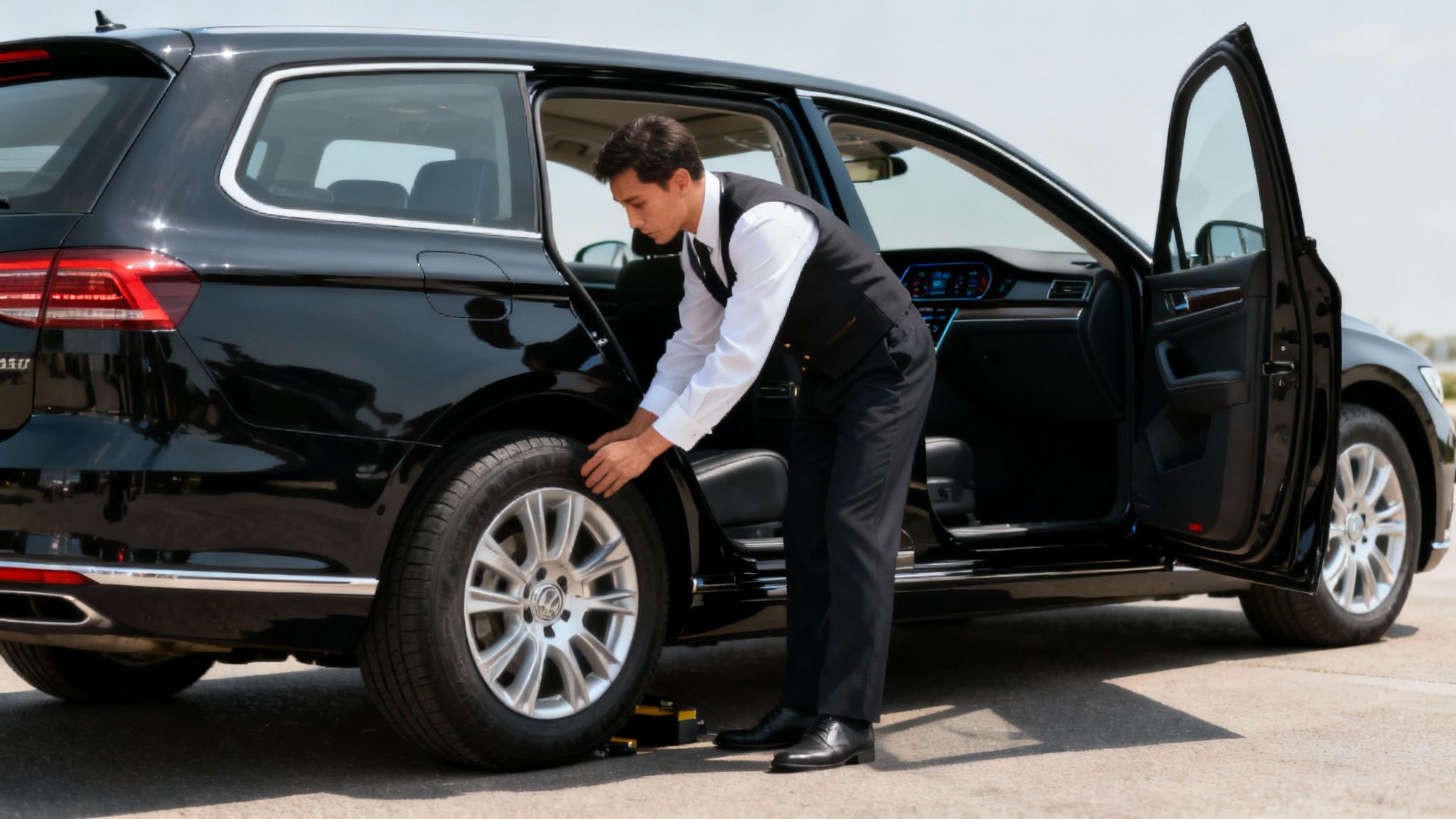
Our fleet is not just selected for comfort and style; it is chosen for its outstanding safety credentials, equipped with the very best active and passive systems. But we go much further. Every vehicle undergoes a stringent, proactive maintenance schedule that exceeds manufacturer recommendations. This makes certain that every system, from the Autonomous Emergency Braking sensors to the tyre pressure monitors, is functioning perfectly when you step inside.
A car’s safety rating is a snapshot in time. Consistent, meticulous maintenance is what guarantees those systems remain effective day in, day out, ensuring reliability and peace of mind on every trip.
This dedication to mechanical excellence is matched only by our investment in the professionals behind the wheel.
The Human Element in Vehicle Safety
Ultimately, the most critical safety feature in any vehicle is a skilled, alert, and responsible driver. Technology provides a vital safety net, but a professional chauffeur’s judgement, anticipation, and calm handling of road conditions are what truly define a safe journey. This is why our selection process is so rigorous.
Every chauffeur at Executive Event Transfers is not just an expert driver, but a vetted professional you can trust implicitly. Our screening process includes:
- Enhanced DBS Checks: A comprehensive background check to ensure complete client security.
- Regular Licence Reviews: Ongoing verification of a clean and exemplary driving record.
- Extensive Road Knowledge: In-depth familiarity with the routes across Kent, London, and the South East.
Furthermore, we are proud members of the Guild of Professional Chauffeurs, which demands adherence to the highest industry standards for conduct, skill, and service. You can learn more about what this means for your safety by exploring our commitment to the Guild of Professional Chauffeurs.
By combining meticulously maintained, high-specification vehicles with elite, thoroughly vetted drivers, we create an environment of total safety. We understand that our clients expect nothing less, and our entire operation is structured to deliver that assurance, from the moment you book to your final destination.
What to Ask When Booking Chauffeur Services
When you book a premium car service, your peace of mind is everything. The best way to ensure a provider’s safety standards meet your expectations is to know the right questions to ask. It arms you with the information you need to choose a service that genuinely prioritises your well-being, not just one that says it does.
Start with the vehicle itself. A simple, direct question like, “What is the age of the car, and does it have a 5-star Euro NCAP rating?” immediately sets a high bar for safety. This single query confirms you will be travelling in a modern vehicle packed with effective safety features.
From there, it is time to dig a little deeper into the operational standards that back up the technology.
Your Essential Safety Checklist
To make sure every part of your journey is secure, do not hesitate to ask the following:
- Vehicle Maintenance: Can you walk me through your vehicle maintenance schedule, especially how often the advanced safety systems are checked?
- Driver Vetting: What does your driver screening process involve? I am interested in background checks and regular licence verification.
- Professional Training: What kind of advanced or defensive driving training have your chauffeurs completed?
- Licensing & Insurance: Is the company fully licensed for private hire, and can you confirm you hold comprehensive hire and reward insurance?
Asking these questions is a crucial part of your due diligence. For more detailed advice, our guide on how to hire a chauffeur breaks everything down even further.
Your Car Safety Questions Answered
Understanding the ins and outs of vehicle safety can feel a bit technical, so we have put together answers to a few common questions. Our goal is to give you clear, straightforward insights and demystify what keeps you protected on the road.
What Is the Most Important Safety Feature in a Car?
While cutting-edge systems like Autonomous Emergency Braking get a lot of attention, decades of crash data and expert analysis point to one simple device: the seatbelt. It remains the single most important piece of safety equipment in any vehicle and the absolute cornerstone of occupant protection.
The seatbelt is designed to work in perfect harmony with a car’s airbags and its structural safety cell, holding you securely in place during a collision. But its life-saving potential is only unlocked when it is worn correctly, on every single journey, no matter how short.
Are More Expensive Cars Always Safer?
Not necessarily. It is true that luxury vehicles often debut the very latest safety technologies, but many affordable modern cars now achieve top marks in rigorous tests from independent bodies like Euro NCAP. It is far more important to check a specific model’s safety rating and standard features list than to assume a higher price tag guarantees better protection.
A key factor here in the UK is that crucial active safety systems like Electronic Stability Control (ESC) and Anti-lock Brakes (ABS) are now mandatory on all new cars. This has created a much higher baseline for safety across the board, levelling the playing field between budget and premium models.
How Do I Know If My Car’s Safety Features Are Working?
Most modern vehicles run an automatic self-check of their active safety systems every time you start the engine. If a fault is found in a system like the airbags, ABS, or ESC, a warning light will pop up on your dashboard. Think of it as your car telling you it needs a professional inspection.
As for passive features, things like seatbelts should be visually checked for any signs of fraying or damage. But ultimately, sticking to a regular servicing schedule with qualified technicians is the most reliable way to ensure all safety features for cars are maintained and functioning as they should. It is a standard we rigorously uphold for every vehicle in our fleet, just as you would expect from a premium airport chauffeur service in London.
For a journey where safety is never in question, trust Executive Event Transfers. Our commitment to meticulously maintained vehicles and professionally vetted chauffeurs ensures your complete peace of mind. Book your secure and reliable transfer today.


